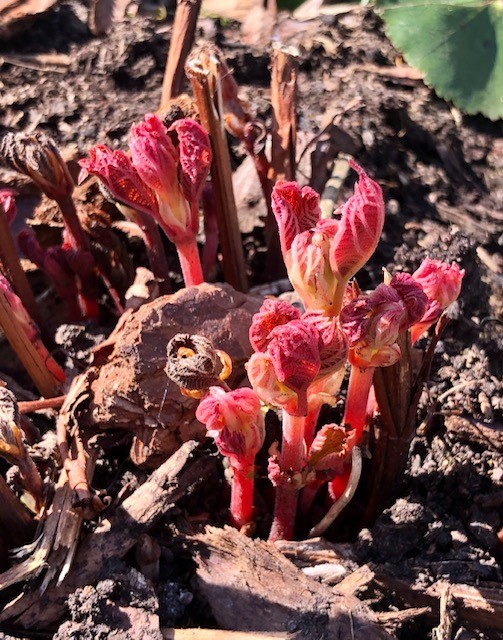
Fortuitously, Tuesday morning’s per chance photograph captured a fleeting moment; that of the glistening, delectable new shoots of Boehmeria. The subsequent frost that followed deemed Wednesday morning’s display decidedly more on the brown, crispy side.
For now, I’ll consider ‘shoots’ in a more colloquial vernacular splitting those that appear at Jubilee Road into three non-botanical, slightly more evocative, categories; ferny ones, strappy ones and bobbly ones, I’ve saved the best until last. Do not get me wrong I have always had a penchant for botanical nomenclature, my brain seems somehow adeptly tuned for the order and the categorisation of the subjects. Scientific names just seem to stay with me and their appearance rarely leaves my mind, I never forget a face, occasionally I forget a plant. I think all of this is about observation, some people don’t look hard enough and some people never see at all. We learn a prescribed description in order to ‘agree’ across the board on plant morphology; pedunculate, pinnate and sessile all refer to leaves but I shall set all of this aside and have fun describing to you the treasures in my garden in my own descriptive way.
There is a point and I can’t pin point its exact juncture but it is a regular occurrence year on year. For me this epiphany or eureka moment happened this year around a week ago. I’m not talking about those precious, diminutive winter flowers or the signs of the first showier garden cherries, it’s the moment where you stop and realise everything is GROWING. I ponder whether this moment is defined by excitement, this would be true but what truly fascinates me and I hope many can relate, is there’s actually a slight underlying element of surprise, as if despite all your efforts you thought it might not happen this year. I find this moment particularly prevalent in my own garden.
Ferny ones; as if delicately snipped with scissors, chewed on by a passing (frequently in my case) puppy or more brutishly chowed (yes chowed) on by a passing flail. I have a few treasures that fall into ferny but a couple stand out for their emergent terrestrial display, that is after all the focus of this article, I’m known for tangents. I grow the Baltic parsley, Cenolophium denudatum here it subtends a moor grass, it’s shoots in comparison barely two or three inches high. Cenolophium’s rusty red emergent foliage soon changes to glossy green making for a subtle contrast as it catches the light. Self-seeders can be nuisance, particularly when they’re weeds, however the coveted pinnacle for me is when plants you have introduced start to choose their own positions. When Foeniculum vulgare starts to do this one does not warrant a pat on the back but it is welcome and joyous all the same. Foeniculum vulgare is more humbly referred to as Fennel, it is the freshest light green, ferniest of the ferny and thankfully one of the first perennials in my garden to show signs of the new growing season.
I’m rather pleased with my autumn planting of strappy leaved Eryngium pandanifolum ‘Physic Purple’, it has grown well over the winter here and adds to my matrixed theme of South American representatives of this Genus threading through the garden, I note seeing three species in the countryside near the dreamy town of Colonia in Uruguay, one as a lithophyte right on the beach. Note to self to trial more of the Old World selections, I rarely use them although often admire their intensity. Strappy leaves are rather dominant here; foxtail lilies, day lilies, african lilies, Astelia, Allium and let us not get started on the grasses.
I will however mention one. Calamagrostis x acutiflora ‘Karl Foerster’ for its upright form is undoubtable key in the latter part of the summer but here it is its two foot high fresh green growth that provides such wonderful movement amongst the lower more static flowers, at this time of the year that is to be celebrated.
One could be forgiven for thinking ‘bobbly ones’ was an easy way to classify everything else. Truth be told, this adjective couldn’t be more apt for describing one particular genus, and that’s why I chose it. Podophyllum’s new shoots are so appealing as much as you just want to marvel at the intricacy of these fleshy umbrellas pushing through the earth, you also feel the need to poke and squeeze them. As a child I was obsessed with peeling apart Sedum leaves, it’s a similar impulse. The leaves of these rhizomatous perennial May apples as they are commonly known are some of the most sumptuous of all perennial plants. ‘Spotty Dotty’ thrives amongst the myriad foliar foil beneath the ‘Bramley’, it’s well on its way now. Slower to emerge and admittedly with a little impatient delving and tinkering from me is Podophyllum mairei, I’m excited about this one, its new and subtler appearance more to my taste.
 thebeginningofitall