The first early signs of bees in the garden is something I find particularly joyful and something to which all gardening folk can relate. If one wasn’t so inclined to notice such things, Poppy, my sixteen-week-old puppy’s marauding tendencies highlight each little flighty pollinator as it flits from flower to flower, each unduly trampled as she snaps in their general direction. ‘Poppy NO’
Our native wood spurge is certainly a favourite for them this morning. The cyathiums like a delectable saucer as the nectar glands glisten in this early bright light. Here at Jubilee Road I grow a selection of the native species, Euphorbia amygdaloides var. robbiae. Its flowers may well be stealing the show this late March morning but their glossy leaves are a must in the rather complex palette of plants I have chosen to establish under the ‘Bramley’ apple tree. In time it will need taming to ensure its neighbours aren’t muscled out from their part of the show but this is the beauty of your own garden (I prefer and shall use ‘creation’ from now on); a watchful eye means these dynamics are predicted and delicately interfered with. After all, as gardeners, that’s what we are, artistic interferers.
No piece of writing would be complete without a photograph. Therefore, if my ramblings are nothing but whimsical self-indulgence and if you’ve got this far the picture should be some respite. When we bought the house in June 2017 the garden comprised a weedy lawn, a lot of concrete, bindweed and one or two rather unchoice plant species.
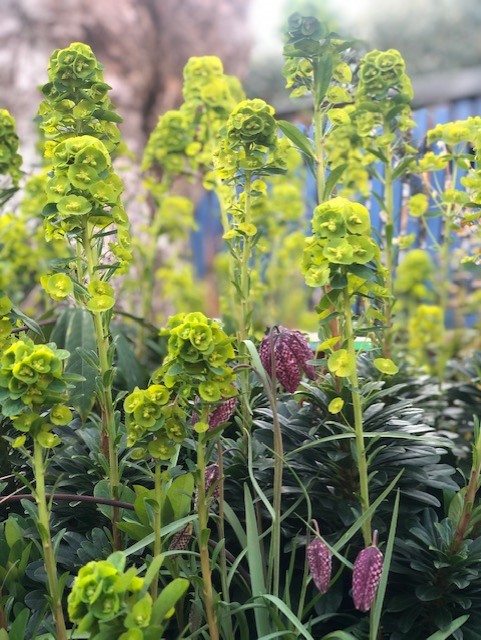
Unaware of my humble horticultural heritage the new neighbours looked on seemingly appalled as on first arrival, keys in hand, I hacked and filled the green bin with an unsuspecting Euonymus fortunei ‘Emerald n Gold’. However, the house built around 1900, surely must at one time or another have had a loved garden. Obvious signs were the handsome ‘Bramley’ that is now a feature tree and the enriched black sandy soil hidden beneath the wildlife friendly ‘lawn’. More hidden evidence came in the emergence of various geophytes in Spring 2018 amongst new plantings in the by then tilled and mulched soil. In the picture the preserved Snakes-head Fritillaries mingles with the aforementioned Euphorbia, aka Mrs Robb’s bonnet.
 thebeginningofitall