Author Archives: jezstamp

SANCTUARY

We always think of sanctuary as somewhere to retreat to but in a way sanctuary could be somewhere we find ourselves then take that new self into the wider world in a happier more self expressed way. 

I ponder the idea that self-expression is freedom and if we have true freedom do we find sanctuary in many things rather than seeking the solace of just one place. I feel my garden has provided me with both; a particular place of safety in the first of what I call, dark times, in my adult life. I ponder that in fact, sanctuary is more of a feeling that a specific place exemplifies. We all have places of restoration, spots we know and love and resonate with. For me Ladle Hill, a Celtic hillfort I visit weekly, the bluebells in the woodland behind my parent’s house, the early purple orchids and the badgers that live there, the wild flower rich Lime Quarry in Old Burghclere or just a peaceful garden.  All of these places allow me to see the world in an uncompromised or as I say, an untouchable way, people can’t take any of those things away from me because they’re all about how I experience them. 

In today’s society many feel the need to conform to things or to look a certain way. These are things I never feel stifled or pressured by, but, maybe, the idea of not being like this and being different puts oneself in an isolated bracket on a journey to true happiness, surely to be found in said sanctuary.

Let me take a little interlude from these philosophical ramblings and introduce you to..

My garden, my sanctuary, my painter’s palette, my favourite place in the world.  Imagine having lots of clothes and never being allowed to wear them, or more to the point, imagine having lots of fancy clothes too bold or too special for the every day. That’s a bit how I felt with the plants I collected or even the plants I just admired and loved but the special moment came when I finally had my own house with a garden.

I think the idea of getting to know a plant is something people can often misconceive. I’ve always had a certain knack to remembering the names, the heights, flowering periods and colours of plants. These are all useful bits of information to compile schemes and planting lists, of course I speak as a professional garden designer here too. 

Getting to know a plant is like getting to know a person, what they’re like on a good day, what they’re like on a bad day, how they react when it’s hot, when it’s cold and also why you love them so but you can’t always explain it.  We can’t of course get to know all plants like this, the same as the people in the world we’ll never meet, but we can at least try and have the opportunity to experience their ‘characters’ in a more intimate way at home. Each and every one earning their keep for that special reason!

It would be all too easy to find oneself filling this piece of prose with myriad specific epithets, highlighting the genera that I find so beguiling but instead I choose to ponder why they found their place beyond their more foliar and botanical adornment.  

Woody plants were the first to capture my heart, one could suggest that as a young man on a, at the time unknown, journey to a lifelong obsession with plants, this was a more manly approach.  The acceptable love of ‘flowers’ coming later.  This however, I believe to be far from true, I always had a penchant for being different.  

Many of us were lucky enough to have been read Wind in the Willows, the idea that the wood behind my parent’s house was filled with woodland creatures one could see as friends, as characterful and intriguing as Moley, Ratty and Badger, even Toad too, I found most comforting.  As I grew older I realised they couldn’t chat away in the way I dreamed they did but as a grown man one thing is for sure, they are most definitely my friends.  I guess my point is one of two parts, comfort and adventure, two adjectives of juxtaposing description but I will endeavour to allude to the two of them to describe why woody plants were the first to capture my heart.  

When I was little I enjoyed making miniature gardens from moss, pebbles and picked flowers, some even had a water feature.  I find a parallel here with the nursery tree wires at Penwood.  Line upon line of trees, each with majestically shaped leaves, coexisting with each other in transitory happiness.  My first observations were of course spontaneous and uneducated but I do vividly remember my first walk down Penwood’s drive, a clear blue, almost autumn like late August/early September morning, the driplines on the tree wires were on and remember thinking, gosh, this feels like home.  Hillier’s Manual of Trees and Shrubs became my Wind in the Willows and as devout as I was to the cause I set about learning and applying every page.  I always found it very important to tell people a plant’s provenance, although to some degree this could be utilised to understand it’s further cultivation, I think at the time it was less high brow than that.  It was about adventure every day at work, plants from, almost, all over the world, the first representations of countries that at the time I’d only dreamed of visiting.  I remember my excitement when I started to realise how many plants on the nursery came from Mexico, from an oak on the wires, to alpines in the frames and a wall shrub or two in the greenhouse.  This was perhaps the start of my love of Latin America, I would go on to reacquaint myself with many of these plants throughout South America, most notably in Chile and Argentina, but I digress.  

So to the woody plants that adorn my sanctuary, the comfort they provide on a bad day, the joy on a good day and the constant reminder of adventure just around the corner.  The heir to the throne reportedly talks to his plants, I understand the sentiment and I too have a deep and meaningful relationship with mine that I retreat to and seek refuge in until darkness falls on most clement and some most inclement evenings too.  

There’s not much room for woody subjects in my small victorian terrace garden, the inherited Bramley apple tree is a magnificent thing with handsome bark.  Rightfully so this is a nod to an early custodian of the garden, I’d imagine harking back to when the terrace was first built at the turn of the 19th century, the enriched organic soil I discovered beneath a shameful ‘lawn’ was another clue of previous care and enrichment.   

There are, at least at my time of writing this, four categories into which I put plants that find a place in one’s own botanical ark.  Firstly, there’s those you simply cannot bare to be without, not just on botanical merit but in some way they seem to define you and therefore must come with.  Then there’s the ones that got away, whether it be space, timing or memory they’ve always been on your ‘hit-list’ but somehow have evaded capture.  Thirdly, and this is the real troublesome one, the unknown, gathered from the depths of temperate pick n mix ‘rainforest’ (I believe locating them is a little trickier than this).  These botanical odysseys wave their little planty heads above the nursery beds as if they already had a presage for one’s taste. We of course all snap them up with great promises of hardiness and not a care in the world that they’ve cost an arm and a leg and we’ve nowhere to put them.  Finally there’s the mistakes, my favourite and last flower justification category, these are left overs, from jobs, or previous gardens/pot collections and they end up being the signatures or those that tie it all together as if you always intended.  However, I ponder more recently and as a natural sub-analyser, perhaps they’re not mistakes but intuitive forethought we made far before we new or didn’t know we were so clever.  

I feel if my relation to sanctuary has not in some way been conveyed in this piece then one great triumph will at least be amusing to those planty folk that know me, I’ve written this and not mentioned a single botanical name.  Why?  Well I rather hoped people that don’t share a love for my subject could read this and at least relate the importance and escapism of immersion in a passion.  Having a candle of passion that always burns in ones mind and keeps the darkest of dogs from the door is the most empowering freedom and hope one can have.  Make sanctuary transitory and carry it with you everywhere.  

Jez Stamp       
Shoots and the Marchtales

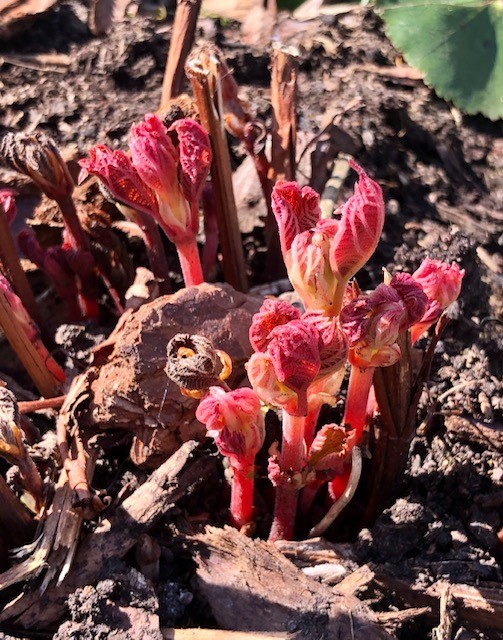
Fortuitously, Tuesday morning’s per chance photograph captured a fleeting moment; that of the glistening, delectable new shoots of Boehmeria.  The subsequent frost that followed deemed Wednesday morning’s display decidedly more on the brown, crispy side.

For now, I’ll consider ‘shoots’ in a more colloquial vernacular splitting those that appear at Jubilee Road into three non-botanical, slightly more evocative, categories; ferny ones, strappy ones and bobbly ones, I’ve saved the best until last.  Do not get me wrong I have always had a penchant for botanical nomenclature, my brain seems somehow adeptly tuned for the order and the categorisation of the subjects.  Scientific names just seem to stay with me and their appearance rarely leaves my mind, I never forget a face, occasionally I forget a plant.  I think all of this is about observation, some people don’t look hard enough and some people never see at all.  We learn a prescribed description in order to ‘agree’ across the board on plant morphology; pedunculate, pinnate and sessile all refer to leaves but I shall set all of this aside and have fun describing to you the treasures in my garden in my own descriptive way.

There is a point and I can’t pin point its exact juncture but it is a regular occurrence year on year.  For me this epiphany or eureka moment happened this year around a week ago.  I’m not talking about those precious, diminutive winter flowers or the signs of the first showier garden cherries, it’s the moment where you stop and realise everything is GROWING.  I ponder whether this moment is defined by excitement, this would be true but what truly fascinates me and I hope many can relate, is there’s actually a slight underlying element of surprise, as if despite all your efforts you thought it might not happen this year.  I find this moment particularly prevalent in my own garden.

Ferny ones; as if delicately snipped with scissors, chewed on by a passing (frequently in my case) puppy or more brutishly chowed (yes chowed) on by a passing flail.  I have a few treasures that fall into ferny but a couple stand out for their emergent terrestrial display, that is after all the focus of this article, I’m known for tangents.  I grow the Baltic parsley, Cenolophium denudatum here it subtends a moor grass, it’s shoots in comparison barely two or three inches high.  Cenolophium’s rusty red emergent foliage soon changes to glossy green making for a subtle contrast as it catches the light.  Self-seeders can be nuisance, particularly when they’re weeds, however the coveted pinnacle for me is when plants you have introduced start to choose their own positions.  When Foeniculum vulgare starts to do this one does not warrant a pat on the back but it is welcome and joyous all the same.  Foeniculum vulgare is more humbly referred to as Fennel, it is the freshest light green, ferniest of the ferny and thankfully one of the first perennials in my garden to show signs of the new growing season.

I’m rather pleased with my autumn planting of strappy leaved Eryngium pandanifolum ‘Physic Purple’, it has grown well over the winter here and adds to my matrixed theme of South American representatives of this Genus threading through the garden, I note seeing three species in the countryside near the dreamy town of Colonia in Uruguay, one as a lithophyte right on the beach.  Note to self to trial more of the Old World selections, I rarely use them although often admire their intensity.  Strappy leaves are rather dominant here; foxtail lilies, day lilies, african lilies, Astelia, Allium and let us not get started on the grasses.

I will however mention one.  Calamagrostis x acutiflora ‘Karl Foerster’ for its upright form is undoubtable key in the latter part of the summer but here it is its two foot high fresh green growth that provides such wonderful movement amongst the lower more static flowers, at this time of the year that is to be celebrated.

One could be forgiven for thinking ‘bobbly ones’ was an easy way to classify everything else.  Truth be told, this adjective couldn’t be more apt for describing one particular genus, and that’s why I chose it.  Podophyllum’s new shoots are so appealing as much as you just want to marvel at the intricacy of these fleshy umbrellas pushing through the earth, you also feel the need to poke and squeeze them.  As a child I was obsessed with peeling apart Sedum leaves, it’s a similar impulse.  The leaves of these rhizomatous perennial May apples as they are commonly known are some of the most sumptuous of all perennial plants.  ‘Spotty Dotty’ thrives amongst the myriad foliar foil beneath the ‘Bramley’, it’s well on its way now. Slower to emerge and admittedly with a little impatient delving and tinkering from me is Podophyllum mairei, I’m excited about this one, its new and subtler appearance more to my taste.

Boehmeria


My garden, day one; lockdown

The first early signs of bees in the garden is something I find particularly joyful and something to which all gardening folk can relate.  If one wasn’t so inclined to notice such things, Poppy, my sixteen-week-old puppy’s marauding tendencies highlight each little flighty pollinator as it flits from flower to flower, each unduly trampled as she snaps in their general direction.  ‘Poppy NO’

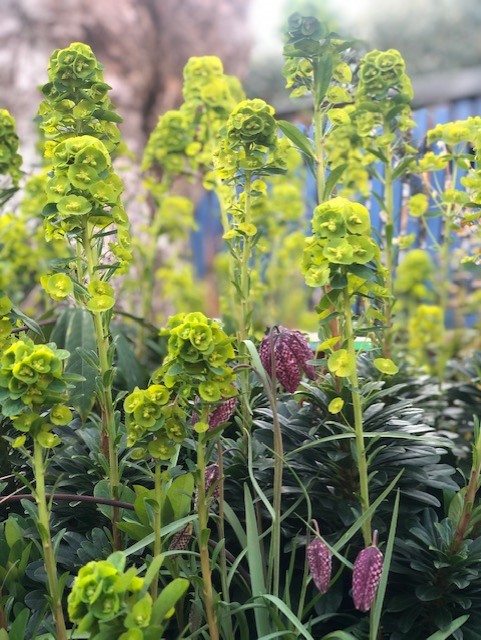
Our native wood spurge is certainly a favourite for them this morning.  The cyathiums like a delectable saucer as the nectar glands glisten in this early bright light.  Here at Jubilee Road I grow a selection of the native species, Euphorbia amygdaloides var. robbiae.  Its flowers may well be stealing the show this late March morning but their glossy leaves are a must in the rather complex palette of plants I have chosen to establish under the ‘Bramley’ apple tree.  In time it will need taming to ensure its neighbours aren’t muscled out from their part of the show but this is the beauty of your own garden (I prefer and shall use ‘creation’ from now on); a watchful eye means these dynamics are predicted and delicately interfered with.  After all, as gardeners, that’s what we are, artistic interferers.

No piece of writing would be complete without a photograph.  Therefore, if my ramblings are nothing but whimsical self-indulgence and if you’ve got this far the picture should be some respite.  When we bought the house in June 2017 the garden comprised a weedy lawn, a lot of concrete, bindweed and one or two rather unchoice plant species.

Fritillaria

Unaware of my humble horticultural heritage the new neighbours looked on seemingly appalled as on first arrival, keys in hand, I hacked and filled the green bin with an unsuspecting Euonymus fortunei ‘Emerald n Gold’.  However, the house built around 1900, surely must at one time or another have had a loved garden.  Obvious signs were the handsome ‘Bramley’ that is now a feature tree and the enriched black sandy soil hidden beneath the wildlife friendly ‘lawn’.  More hidden evidence came in the emergence of various geophytes in Spring 2018 amongst new plantings in the by then tilled and mulched soil.  In the picture the preserved Snakes-head Fritillaries mingles with the aforementioned Euphorbia, aka Mrs Robb’s bonnet.

The Potential of Newbury’s Urban Wastelands

The old Travis Perkins site on Mill Lane, Newbury in its current desolate, adandoned state, has a hidden beauty before it’s inevitable face lift.  In its current untamed state, it for a second, symbolises our thankfully still remaining fagility against nature.  Machete in hand, a 30 minute frenzy of sweat and exhaustion in the sub tropical jungles of eastern Bolivia outlined a refreshing human helplessness in me against nature.  I had done little to tame the Chusquea ridden thickets of impenetrable scrub. In a similar way, plants have so easily colonised the forsaken site on Mill Lane, thickets of Rosebay Willowherb in the expansion joints, clumps of Buddleia sprouting from the fragile tarmacadum edges and a beautiful dusting of moss on the northerly walls.

Driving past one day, struck by the emptiness and potential of the site, I was filled with an idea.  I saw an urban food forest, a haven of sustainable perennial crops, a community food source, an anti Tesco, a place where people could grow plants together, be educated and take home Newbury grown, globally inspired food.  A place where native crabs, thorn and sloe mingle with the likes of Szechuan Pepper, Siberian kiwis and Goji berry.  Anyone who’s interested could be involved in what would be our huge living grocery store, and what’s funny is, it couldn’t not work!  These plants want to grow, lots of them, given a little encouragment, can be, quite frankly, thugs.  The focus would be organic, perennial crops growing in relative harmony, cutting out the need for excessive labour, herbicides and annual re-planting.

Sadly, no doubt the site has already been snapped up by short sighted, capital hungry developers.  My ideas will be seen by many as bohemian and futile but when you think about it, they are educated, sensible, blindingly obvious and perhaps, just perhaps, completely necessary if Newbury wants to be a town for the future.  As coporate giants offset their carbon footprints with irrelevant, policy satisfying, box ticking ridiculousness, let’s do something exciting.  Who’s with me?

a frosty morning at home

Our locally grown, locally sourced, locally scrumped, arduously pulped, pressed and pasteurised apple juice was toast of the day yesterday evening, mulled into a piping hot winter warmer, bubbling away on the stove for the crowds of food lovers and seekers of early festive spirit alike.  The crisp evening was perfectly apt for the turning on of the christmas lights, the sky was clear, decorated with stars, our first proper frost this winter season.

Christmas is an evocative time for many, the true meaning of this seasonal festival has become a bit of a fallacy, do gooders blame our materialistic modern consumerism, ‘christmas has become too commercial’, I say nonsense, the true spirit of christmas remains dear to us all, whatever it may be and that is what’s important.  The Pagan celebration of Yule, one of the traditional Celtic Fire Festivals welcomes the return of the light on the 21st December, the longest night of the year, some suggest christianity hijacked this ancient festival for the celebration of the birth of Jesus Christ.

The hybridisation of family, paganism, christianity and an interaction with mother natures cycle are what makes this midwinter festival so important to me.

The frost was glistening white this morning, covering the fields and the hedgerows with a magical, silvery sheen.  The sun’s warmth was suprising, our hedgerow friends having endured the bitter night will have welcomed the breaking of the dawn and the sign of a new day.  Most of us are sadly, so far removed from the daily struggle that is the cycle of nature for the birds and animals that inhabitat our winter landscape we rarely spare it a thought.  I often think of the preparations of a safe leafy bed for the night, the detailed organisation of a winter’s food store, exploration of nature’s larder, dodging from bramble to toadstall, Winifred Mouse, Ratty, Moley, Badger the heroes of my childhood books, I secretly still hope its all real, why couldn’t it be?

The diesel fuelled tracks of destruction gorging their way through the landscape made it difficult for me to find my balance, at times the wheels of my push bike spinning frictionless as I gingerly steered myself through the muddy quagmire.

The 4×4, the ever necessary vehicle of choice for the ‘countryperson’, call me cynical but I wonder if during their 12 bore yielding, chelsea tractor revving, frenzy of blood fuelled weekend sport they for a second, appreciate their surroundings that could so easily slip away from us, unnoticed and forgotten.

Alongside these tracks of destruction a copper carpet of leaves slinking its way down the steep incline to my right, permeatted by the smooth, grey stems of the beech, all closely planted, their higher canopies throwing out contorted limbs in the fight for light with the occasional fusion of cambial tissue creating creature like contortions and shapes.  At the base of the incline a wide linear thicket of wild damson, absent of fruit, shone, their still heavily foliated branches smothered in butter yellow tear drops ready to drop lifelessly at the next visit from Jack Frost.

The gently mown pasture was a lovely way to descend, the light dusting of moisture on the sward zipped from my tyres as I meandered my way through the sheep that blinked, suprised but unphased, by my sudden arrival through the low hanging mist, the light beginning to fade.

There was a calm in the air today, I’m glad I made the time to find it.

A Calming Haze

the first of a few

My Peugeot groaned in second gear, the steep incline of Nuthanger proving as testing as it is on my calves on my trusty Trek 1800 or a name something like that.  The break through the trees that overhang the road revealed Ladle Hill, quite a spectacle, an ancient avenue of beech giving way to a beautiful nothingness in either direction, to the left a horizontal flat plateau extending toward Kinsgclere and to the right the anicent hummocking burial mounds of our Celtic cousins.

Taking all this in this afternoon I realised what a special place in my heart this area holds, deeply ingrained in who I am, its been the shaping of me, growing up here the beauty of the landscape has always been inherrent but I feel each day as I learn and understand to read it more its hold on me only gets stronger.  I may move away soon perhaps far, far away or perhaps merely a short distance, maybe for a while or perhaps for a long while either way I know one day it’ll call me back.

As I bundled bunches of Hawthorn berries from our native Crataegus into my container on Watership Down and a stones throw from one of my father’s childhood homes I didn’t feel what I was doing was special, I’ve done it many times before and so have many, many before me but I felt pleased that I was doing it all the same, satisfied in fact that I myself in my lifetime already haven’t been shortsighted enough to forego the wonders and abundance of nature and it’s larder.

Sadly for many this year’s apple crops have been low, stone fruit such as plums and gages have come in meagre quantities but our cultivated and native thorns have been laiden with fruit this year, current weather forecasts predicting a bleak winter  leads me to the old saying ‘many haws, many snaws’ a suggestion of the severity of the subsequent winter, but what would I know.